Regulates gut-brain axis / supports motility and neurointestinal communication
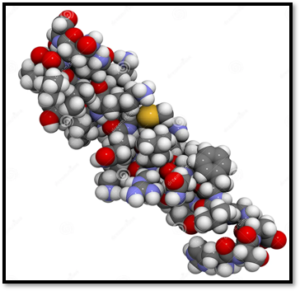
VIP (Vasoactive Intestinal Peptide) is a 28-amino-acid hormonal peptide that regulates smooth muscle function and cellular secretion across multiple biological systems
R$ 1.242,00
10 in stock
💡 Digite seu CEP para calcular automaticamente o frete e prazo de entrega
We accept USDT as our exclusive payment method, ensuring fast transactions, enhanced privacy, and efficient order processing.
Warning — For Research Use Only
Scientific content intended for research laboratories only. It is not a clinical, therapeutic, or diagnostic recommendation. Use is restricted to qualified professionals. Consult specialists before purchasing or using. Biopelabs reinforces its commitment to ethical and responsible use.
Discover Our Complete Catalog
Browse our full peptide catalog and explore additional compounds. Click any product to view its details and discover more research solutions.
Vasoactive intestinal peptide (VIP) is a 28-amino-acid regulatory hormone that controls smooth muscle relaxation and secretion in various biological systems. This research-grade peptide enables laboratories to investigate VIP’s role in cellular signaling, vascular function, and therapeutic pathways through controlled in vitro studies.
Our pharmaceutical-grade VIP maintains high purity standards for reliable research results. Each batch undergoes rigorous testing to support precise scientific investigations into this important peptide’s regulatory mechanisms and potential therapeutic applications in laboratory research.
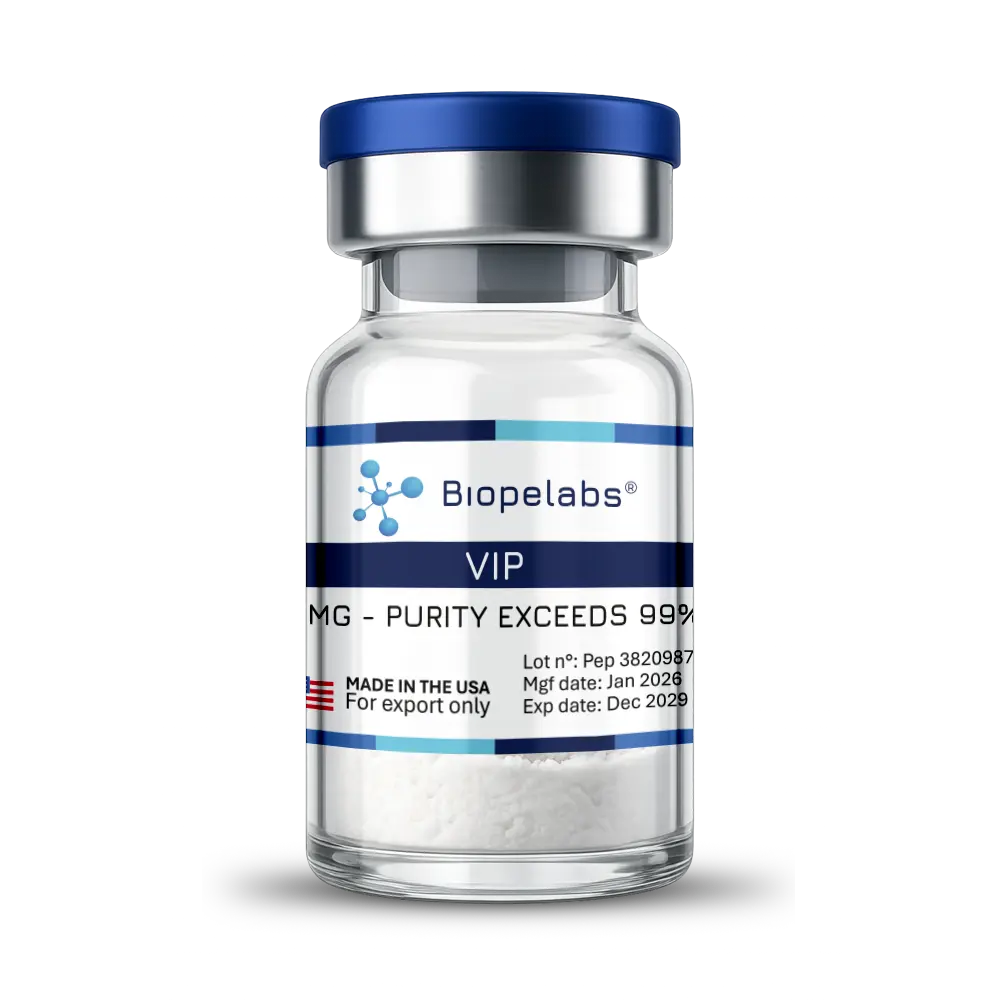
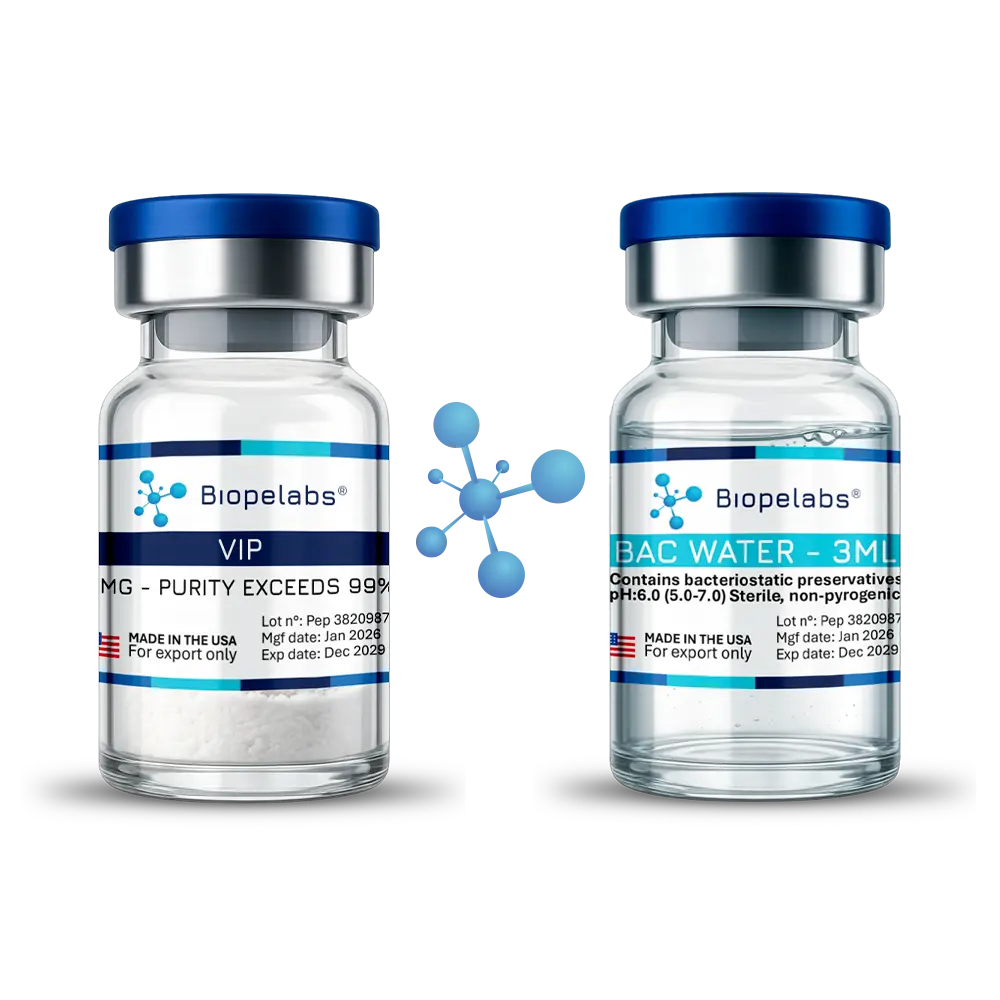
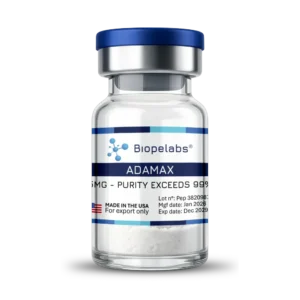
Each vial contains 5 mg of lyophilized VIP. Reconstitute immediately before research use in bacteriostatic water, aliquot for single use, and store at ≤ –20 °C to avoid repeated freeze-thaw cycles.
Peptides undergo a lyophilization process, a technique that contributes to greater stability and durability while preserving purity and molecular structure throughout storage. It is worth noting that no fillers are used during this procedure.
Intended Use
Biopelabs advises: this material is made available exclusively as a chemical raw material for research purposes. Its use is restricted to in vitro assays and experimental activities in a laboratory setting. The information provided is strictly informational and educational in nature. Handling must be carried out only by duly qualified professionals. This product does not qualify as a drug, food, or cosmetic, and must not be used, commercialized, or described as such.
Research
This document presents a technical and academic analysis of Vasoactive Intestinal Peptide (VIP), a 28-amino-acid endogenous neuropeptide with pleiotropic functions in the immune, neurological, and metabolic systems.
1.Scientific Research on VIP (Vasoactive Intestinal Peptide)
VIP is a member of the secretin/glucagon superfamily, originally isolated from the gastrointestinal tract but later identified as a ubiquitous neurotransmitter and neuromodulator. It is produced by central and peripheral neurons, as well as immune cells (T and B lymphocytes). Due to its widespread distribution, VIP operates at the interface between the neuroendocrine and immune systems and is a major focus of research in autoimmune, inflammatory, and neurodegenerative diseases.
2. Mechanism of Action and Inhibition
VIP exerts its functions by binding to two high-affinity G protein-coupled receptors (GPCRs), $VPAC_1$ and $VPAC_2$, as well as a lower-affinity receptor, PAC1.
Cellular Signaling: Binding of VIP to $VPAC_1$ or $VPAC_2$ activates adenylate cyclase, resulting in increased intracellular cyclic adenosine monophosphate (cAMP) levels and activation of protein kinase A (PKA).
Immune Modulation: VIP inhibits the production of pro-inflammatory cytokines ($TNF$-$\alpha$, $IL$-$6$, $IL$-$12$) and stimulates the production of anti-inflammatory cytokines such as $IL$-$10$. It also promotes the differentiation of naïve T cells into regulatory T cells (Tregs).
Inhibition: VIP activity is naturally limited by enzymes such as dipeptidyl peptidase-IV (DPP-IV) and other neutral endopeptidases that cleave the peptide, reducing its bioavailability. Research utilizes specific antagonists such as $[D\text{-}p\text{-}Cl\text{-}Phe^6, Leu^{17}]\text{-}VIP$ to selectively block its receptors in experimental models.
3. Investigated Metabolic Impacts
VIP plays a crucial role in regulating energy metabolism and glucose homeostasis:
Endocrine Pancreas: VIP stimulates glucose-dependent insulin secretion and glucagon release, acting as a fine regulator of pancreatic islet function.
Hepatic Glycogenolysis: Promotes glycogen breakdown in the liver to supply glucose during periods of increased energy demand.
Circadian Rhythms: VIP is a key neurotransmitter in the suprachiasmatic nucleus (SCN) of the hypothalamus, essential for synchronizing metabolic circadian rhythms and the sleep-wake cycle.
Lipolysis: In adipose tissue, VIP can stimulate lipolysis via activation of the cAMP/PKA pathway.
4. Investigation in Oncological Models
VIP’s role in oncology is dual and context-dependent, making it a complex research target:
Tumor Proliferation: Many solid tumors (breast, prostate, lung, and colon) overexpress $VPAC_1$ receptors. VIP may act as an autocrine and paracrine growth factor, promoting malignant cell survival and proliferation.
Angiogenesis: The peptide stimulates the expression of Vascular Endothelial Growth Factor (VEGF), facilitating tumor neovascularization.
Bioimaging Applications: Due to the high density of $VPAC_1$ receptors in cancer cells, radiolabeled VIP analogs (e.g., with Technetium-99m or Copper-64) are being investigated as high-precision diagnostic tools for metastasis localization.
VIPomas: Neuroendocrine tumors that secrete VIP (Verner-Morrison syndrome) serve as the classical clinical model for studying systemic overexposure to this peptide (watery diarrhea, hypokalemia, and achlorhydria).
5. Pharmacokinetic Considerations in Research
Plasma Half-life: Extremely short, estimated at 1 to 2 minutes in humans, due to rapid proteolytic degradation and hepatic/renal clearance.
Stability: To overcome metabolic instability, pharmacological research focuses on developing stabilized analogs, PEGylated variants, or nanoparticle encapsulation.
Route of Administration: In studies targeting pulmonary diseases (such as sarcoidosis or pulmonary hypertension), inhalation is often preferred to minimize systemic side effects (e.g., hypotension) and maximize local concentration.
6. Other Relevant Research Associations
Inflammatory Lung Diseases: VIP is under clinical investigation for the treatment of sarcoidosis and COPD due to its bronchodilatory and anti-inflammatory properties.
Neuroprotection: In models of Parkinson’s disease and Multiple Sclerosis, VIP has demonstrated neuroprotective effects and reduction of microglia-mediated neuroinflammation.
Vasodilatory Effect: It is one of the most potent known vasodilators, reducing systemic and pulmonary vascular resistance.
7. Final Considerations
VIP is a fundamental molecule for understanding the neuroimmune network. For researchers, the main challenge lies in dissociating its potent anti-inflammatory and neuroprotective therapeutic effects from its proliferative potential in oncological contexts and its pharmacokinetic instability. The future of VIP research points toward the development of selective receptor agonists ($VPAC_2$ vs $VPAC_1$) and targeted delivery systems to minimize unwanted vasodilatory effects.
8. References
Gonzalez-Rey, E., Chorny, A., & Delgado, M. (2007). Vasoactive intestinal peptide: an extra-pancreatic master of glucose homeostasis. Trends in Molecular Medicine, 13(2). https://doi.org/10.1016/j.molmed.2006.12.002
Moody, T. W., Nuche-Berenguer, B., & Jensen, R. T. (2016). Vasoactive intestinal peptide/pituitary adenylate cyclase activating polypeptide, and their receptors and cancer. Current Opinion in Endocrinology, Diabetes and Obesity, 23(1). https://doi.org/10.1097/MED.0000000000000218
Prasse, A., Zissel, G., Lützen, N., et al. (2010). Inhaled vasoactive intestinal peptide therapy in sarcoidosis. American Journal of Respiratory and Critical Care Medicine, 182(4). https://doi.org/10.1164/rccm.200909-1440OC
Myong, S., Nguyen, A., & Challa, S. (2024). Biological functions and therapeutic potential of NAD+ metabolism in gynecological cancers. Cancers, 16. https://doi.org/10.3390/cancers16173085
COAs
LAL Endotoxin Test Report
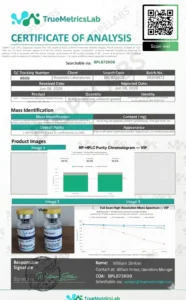
Certificate of Analysis (Including Product Images)
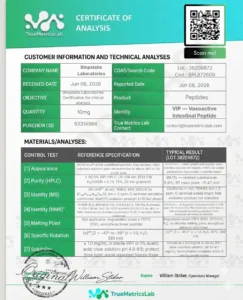
Certificate of Analysis (General / Physicochemical)
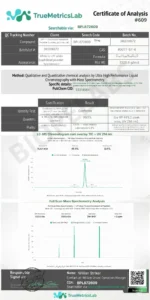
Certificate of Analysis (Analytical Method Details) ✅
Reviews
There are no reviews yet.
Only logged in customers who have purchased this product may leave a review.
Disclaimer: The products offered by BiopeLabs are intended for research and laboratory use only. They are not approved for human consumption, therapeutic, diagnostic, or veterinary use. By purchasing from our website, you acknowledge that you are a qualified researcher or purchasing on behalf of a legitimate research institution and agree to use these products in accordance with all applicable laws and regulations.





Reviews
There are no reviews yet.