
SS‑31 acts as a selective mitochondrial antioxidant by inhibiting cardiolipin oxidation and protecting the integrity of mitochondrial cristae, thereby optimizing the electron transport chain and reducing the generation of reactive oxygen species (ROS). This interaction promotes enhanced cellular bioenergetics and has been studied in the context of neuroprotection, cardioprotection, and diseases associated with mitochondrial dysfunction, in both preclinical models and recent FDA‑reviewed clinical trials for specific indications. Its high purity (>99%) ensures reproducibility and precision in experimental studies, with preferential accumulation in tissues of high energy demand such as the brain and heart.
Important Information
| Property | Value |
| Molecular formula | C₃₂H₄₉N₁₃O₁₀ (sequence: D‑Arg‑Dmt‑Lys‑Phe‑NH₂, where Dmt = 2′,6’‑dimethyltyrosine) |
| Molecular weight | 1,648.79 Da (1,648.79 g/mol) |
| Synonyms | Elamipretide, MTP‑131, Bendavia, Szeto‑Schiller‑31 |
Main structure of the peptide SS‑31
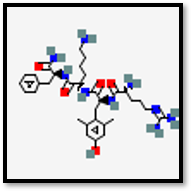
Source: PubChem
Lyophilized Peptides
Peptides undergo a lyophilization process, a technique that contributes to greater stability and extended shelf life, while preserving purity and molecular structure during storage. It is important to note that no fillers are used during this procedure.
Intended Use
Biopelabs states: this material is provided exclusively as a chemical input for research purposes. Its use is restricted to in vitro assays and experimental activities in laboratory environments. The information presented is strictly for informational and educational purposes. Handling must be carried out only by properly qualified professionals. This product is not classified as a medication, food, or cosmetic, and must not be used, marketed, or described as such.
SS-31 is a synthetic low-molecular-weight peptide belonging to the class of mitochondria-targeted peptides. Its sequence (D-Arg-dimethylTyr-Lys-Phe-NH₂) was designed to readily penetrate cell membranes and selectively accumulate in the inner mitochondrial membrane, independent of membrane potential.
Unlike classical antioxidants, SS-31 does not act solely as a scavenger of reactive species, but rather as a functional modulator of mitochondrial bioenergetics. Its primary molecular target is cardiolipin, a phospholipid essential for the structural organization of the electron transport chain.
The peptide has been widely investigated in experimental models related to mitochondrial dysfunction, aging, cardiovascular diseases, and metabolic disorders.
SS-31 exhibits a mechanism of action centered on stabilizing mitochondrial function.
SS-31 does not function as a classical enzyme inhibitor but rather exerts modulatory and stabilizing effects on mitochondrial structures and processes.
Numerous preclinical and clinical studies have evaluated the metabolic effects of SS-31:
The role of SS-31 in oncological models remains limited and is not its primary focus of investigation.
However, some experimental considerations include:
On the other hand:
Thus, the role of SS-31 in cancer remains poorly defined and requires further investigation.
Cardiolipin-targeted mitochondrial protection
The primary specific action of SS-31 is the stabilization of cardiolipin in the inner mitochondrial membrane.
This results in:
This characteristic differentiates SS-31 from conventional antioxidants, as its action is localized and structurally targeted rather than purely chemical.
SS-31 exhibits pharmacokinetic properties consistent with small cationic peptides:
Additional aspects:
Detailed human pharmacokinetics remain under investigation in clinical studies.
SS-31 is frequently studied as a mitochondria-protective agent in various conditions characterized by oxidative stress and impaired bioenergetics.
SS-31 is a mitochondria-targeted peptide with a mechanism centered on cardiolipin interaction and stabilization of cellular bioenergetics. Its effects extend beyond simple antioxidant activity, involving structural and functional preservation of the respiratory chain.
Available data suggest benefits in models of mitochondrial dysfunction, including improvements in energy metabolism, muscle function, and cardiovascular health. However, its clinical application still depends on further validation in controlled studies.
Its current use remains predominantly restricted to experimental and research contexts, particularly in areas related to bioenergetics and mitochondrial medicine.
Szeto, H. H. (2014). First-in-class cardiolipin-protective compound as a therapeutic agent to restore mitochondrial bioenergetics. British Journal of Pharmacology, 171(8), 2029–2050. https://doi.org/10.1111/bph.12461
Zhao, K., Luo, G., Giannelli, S., Szeto, H. H. (2005). Mitochondria-targeted peptide prevents mitochondrial depolarization and apoptosis. Biochemical Pharmacology, 70(12), 1796–1806. https://doi.org/10.1016/j.bcp.2005.09.017
Dai, D. F., Chen, T., Szeto, H., Nieves-Cintrón, M., Kutyavin, V., Santana, L. F., Rabinovitch, P. S. (2011). Mitochondrial targeted antioxidant peptide ameliorates hypertensive cardiomyopathy. Journal of the American College of Cardiology, 58(1), 73–82. https://doi.org/10.1016/j.jacc.2010.12.044
Siegel, M. P., Kruse, S. E., Percival, J. M., Goh, J., White, C. C., Hopkins, H. C., Kavanagh, T. J., Szeto, H. H., Rabinovitch, P. S., Marcinek, D. J. (2013). Mitochondrial-targeted peptide improves mitochondrial bioenergetics and skeletal muscle performance in aged mice. Aging Cell, 12(5), 763–771. https://doi.org/10.1111/acel.12108
Elamipretide Clinical Development Overview (various ongoing clinical studies on SS-31).
Only logged in customers who have purchased this product may leave a review.
| Weight | 40 g |
|---|---|
| Dimensions | 7 × 3,6 × 8 cm |



Reviews
There are no reviews yet.