
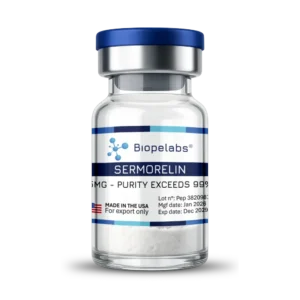
Sermorelin comprises the N‑terminal 29‑amino‑acid sequence of human GHRH, considered the smallest fragment capable of preserving full biological activity.
Its mechanism of action involves binding to GHRH receptors (GHRH‑R) located on somatotropic cells of the anterior pituitary, triggering intracellular signaling that promotes pulsatile GH release and subsequent elevation of insulin‑like growth factor‑1 (IGF‑1).
Historically, this peptide was developed as a diagnostic and therapeutic agent for conditions associated with GH deficiency, while preserving physiological endocrine feedback mechanisms.
Important Information
| Property | Value |
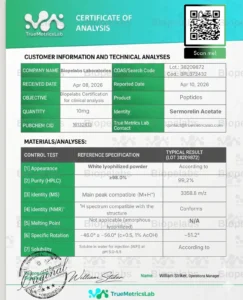
| Molecular formula | C₁₄₉H₂₄₆N₄₄O₄₂S |
| Molecular weight | 3357.9 g/mol (Da) |
| Synonyms | GHRH (1‑29) amide, Growth Hormone Releasing Factor (GRF) (1‑29) amide, Somatoliberin (fragment 1‑29), Sermorelin acetate |
Main structure of the peptide Sermorelin
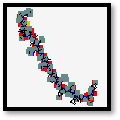
Source: PubChem
Lyophilized Peptides
Peptides undergo a lyophilization process, a technique that contributes to greater stability and extended shelf life, while preserving purity and molecular structure during storage. It is important to note that no fillers are used during this procedure.
Intended Use
Biopelabs states: this material is provided exclusively as a chemical input for research purposes. Its use is restricted to in vitro assays and experimental activities in laboratory environments. The information presented is strictly for informational and educational purposes. Handling must be carried out only by properly qualified professionals. This product is not classified as a medication, food, or cosmetic, and must not be used, marketed, or described as such.
Sermorelin (sermorelin acetate) is a synthetic peptide corresponding to the first 29 amino acids of the Growth Hormone-Releasing Hormone (GHRH). This N-terminal portion is biologically active and sufficient to stimulate the secretion of growth hormone (GH) by the anterior pituitary.
Historically, sermorelin was developed as a therapeutic alternative to exogenous GH administration, aiming to preserve the physiological regulation of the hypothalamic-pituitary-somatotropic axis. Currently, its use remains relevant in experimental and research contexts related to endocrine regulation and metabolism.
Sermorelin acts as an agonist of the GHRH receptor (GHRH-R), located in somatotroph cells of the anterior pituitary.
Main mechanism:
Physiological consequences:
Inhibition/regulation:
No direct inhibitory activity is attributed to sermorelin; its action is predominantly stimulatory within the GH/IGF-1 axis.
Activation of the GH/IGF-1 axis by sermorelin is associated with several metabolic effects:
The GH/IGF-1 axis is widely studied in oncology due to its role in cell proliferation and survival.
Relevant research considerations:
However:
Therefore, this relationship remains under investigation and requires cautious interpretation in experimental contexts.
The primary specific action of sermorelin is the induction of endogenous GH secretion in a physiological and pulsatile manner, distinguishing it from exogenous GH.
Key characteristics:
This property makes sermorelin particularly relevant in studies aiming to modulate the somatotropic axis without disrupting its natural regulation.
Sermorelin exhibits pharmacokinetic characteristics typical of short peptides:
Additional aspects:
Sermorelin is a functional analog of GHRH that stimulates endogenous growth hormone secretion in a physiological manner. Its main scientific relevance lies in its ability to modulate the GH/IGF-1 axis while preserving natural regulatory mechanisms.
The observed metabolic effects are primarily related to increased GH and IGF-1, influencing body composition and lipid and protein metabolism. However, as with other modulators of this axis, its relationship with proliferative processes requires continued investigation.
Its current use remains predominantly restricted to experimental and research contexts, particularly in endocrine and metabolic studies.
Bowers, C. Y. (1998). Growth hormone-releasing hormone (GHRH) and its analogs. Endocrine Reviews, 19(5), 523–541. https://doi.org/10.1210/edrv.19.5.0344
Vance, M. L. (1990). Growth hormone-releasing hormone. Clinical Endocrinology, 33(4), 403–417. https://doi.org/10.1111/j.1365-2265.1990.tb03884.x
Ghigo, E., Arvat, E., Muccioli, G., Camanni, F. (1997). Growth hormone-releasing hormone. Journal of Endocrinological Investigation, 20(6), 345–353.
Iranmanesh, A., Lizarralde, G., Veldhuis, J. D. (1991). Age and relative adiposity are specific negative determinants of the frequency and amplitude of growth hormone (GH) secretory bursts and the half-life of endogenous GH in healthy men. The Journal of Clinical Endocrinology & Metabolism, 73(5), 1081–1088.
Müller, E. E., Locatelli, V., Cocchi, D. (1999). Neuroendocrine control of growth hormone secretion. Physiological Reviews, 79(2), 511–607.
Only logged in customers who have purchased this product may leave a review.
| Weight | 40 g |
|---|---|
| Dimensions | 7 × 3,6 × 8 cm |



Reviews
There are no reviews yet.