
ACE-031 functions as a soluble “decoy” receptor, binding with high affinity to myostatin (GDF-8) and related ligands (such as activins), thereby preventing their interaction with endogenous cellular receptors. Myostatin is a central negative regulator of myogenesis; its inhibition results in:
The fusion to the IgG Fc fragment provides structural stability and an extended plasma half-life, enabling systemic administration with widened dosing intervals. Unlike metabolic agonists or lipolytic agents, ACE-031 does not primarily act on body fat reduction; its effects are muscle-anabolic, with possible secondary changes in body composition stemming from increased lean mass.
The compound was evaluated in early clinical studies for muscular disorders (e.g., dystrophies), but its development was halted due to vascular adverse events observed in clinical phases.
Important Information
| Properties | Value |
| Molecular Formula | ACE-031 has no fixed molecular formula |
| Molecular Weight | ≈ 48–50 kDa |
| Synonyms | ACE-031, ActRIIB-Fc, Myostatin inhibitor (receptor decoy), Activin receptor type IIB–Fc fusion protein |
Main Structure of the ACE-031 Protein
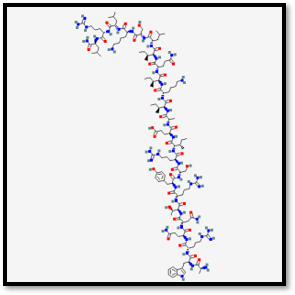
Fonte: científico
Brief Scientific Summary
ACE-031 is a recombinant ActRIIB-Fc fusion protein that inhibits myostatin and related TGF-β family ligands, promoting muscle mass increase by removing physiological blockade of myogenesis, with primarily anabolic and non-lipolytic effects.
Important Technical Note
✔️ Acts directly on the myostatin/ActRIIB axis
✔️ Induces muscle hypertrophy
❌ Not a peptide
❌ Not a metabolic agonist
❌ Not a direct lipolytic agente
Intended Use
Biopelabs warns: this material is provided exclusively as a chemical reagent for research purposes. Its use is restricted to in vitro assays and experimental activities in a laboratory setting. The information provided is strictly informational and educational. Handling must be performed only by qualified professionals. The product is not classified as a medicine, food, or cosmetic and must not be used, marketed, or described as such.
Scientific Research on ACE-031 (ActRIIB-Fc)
ACE-031 is a recombinant fusion protein composed of the extracellular domain of the activin type IIB receptor (ActRIIB) fused to the Fc portion of human immunoglobulin IgG. It is not a simple peptide but a chimeric protein designed to act as a "ligand trap" receptor, sequestering TGF-β superfamily ligands, particularly myostatin (GDF-8) and related proteins.
It was developed as an experimental agent with potential applications in conditions associated with muscle mass loss or deficiency, such as muscular dystrophies, cachexia, and sarcopenia.
Mechanism of Action and Inhibition
ACE-031 functions as a functional inhibitor of the myostatin pathway through extracellular neutralization of its ligands.
Primary mechanism:
Scientifically Investigated Metabolic Impacts
In preclinical models and early clinical studies, the following were observed:
Investigation in Oncological Models
The myostatin/ActRIIB pathway has potential relevance in:
Pharmacokinetic Considerations in Research
As a fusion protein containing an Fc portion, ACE-031 exhibits:
Other Important Existing Research Relationships
Final Considerations
ACE-031 represents a biotechnological strategy based on a "ligand trap" receptor for myostatin neutralization and muscle growth promotion. Although it demonstrated significant muscle mass increases in early studies, its lack of selectivity and systemic adverse effects limited clinical advancement.
From a scientific perspective, it remains relevant as a tool for understanding the ActRIIB/myostatin pathway and developing more selective approaches for muscle growth modulation and cachexia treatment.
References
Lee, S. J. (2012). Regulation of muscle mass by myostatin. Annual Review of Cell and Developmental Biology, 28, 61–83. https://doi.org/10.1146/annurev-cellbio-101011-155836
Campbell, C., McMillan, H. J., Mah, J. K., et al. (2017). Myostatin inhibition in muscular dystrophy. Neurology, 89(2), 127–138. https://doi.org/10.1212/WNL.0000000000004086
Amthor, H., Macharia, R., Navarrete, R., et al. (2007). Lack of myostatin results in excessive muscle growth but impaired force generation. Proceedings of the National Academy of Sciences, 104(6), 1835–1840. https://doi.org/10.1073/pnas.0604893104
Rooks, D., Praestgaard, J., Hariry, S., et al. (2017). Treatment of sarcopenia with a selective androgen receptor modulator and myostatin inhibition. Journal of Cachexia, Sarcopenia and Muscle, 8(6), 933–946. https://doi.org/10.1002/jcsm.12239
Scientific Reviewer
Content reviewed by Dr. Ky H. Le, MD. Dr. Ky H. Le is a family physician in Aiea, Hawaii. He received his medical degree from St. George's University School of Medicine and has been practicing for over 20 years. He has expertise in treating obesity, diabetes, hypertension, and high blood pressure, among other conditions—see all areas of specialization. Dr. Ky H. Le accepts Medicare, Aetna, Humana, Blue Cross, United Healthcare.
Ref.: https://health.usnews.com/doctors/ky-le-371599#expertise
Only logged in customers who have purchased this product may leave a review.
| Weight | 40 g |
|---|---|
| Dimensions | 7 × 3,6 × 8 cm |





Reviews
There are no reviews yet.